From Awakening to Liberation: Joe Hudson on Emotional Practice
Evelyn Reed ·
Listen to this article~4 min
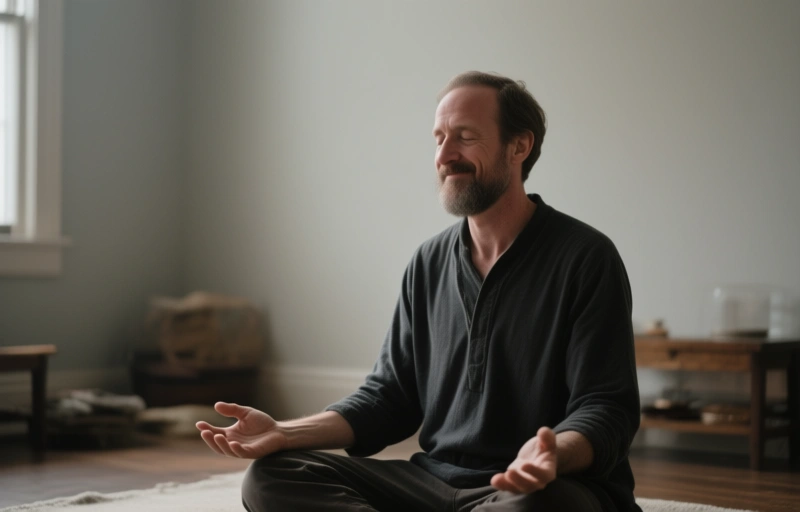
Host Michael Taft and guest Joe Hudson explore the crucial difference between awakening and liberation, and why insight on the cushion doesn't automatically free us in relationship or emotional reactivity.
What happens when your meditation practice leaves you feeling peaceful on the cushion but reactive the moment you step off it? That's the question host Michael Taft and guest Joe Hudson dig into in this eye-opening conversation. They explore the crucial difference between awakening and liberation, and why insight alone doesn't automatically free us in relationship, shame, self-talk, or emotional reactivity.\n\n### The Gap Between Awakening and Liberation\n\nYou might have tasted profound stillness during meditation. Maybe you've even had glimpses of no-self or oneness. But then you get into an argument with your partner, or you notice that inner critic piping up, and suddenly all that insight feels miles away. Joe Hudson argues that's because awakening and liberation are not the same thing. Awakening is the initial recognition of your true nature. Liberation is the ongoing process of untangling the conditioned patterns that keep you stuck. One is a glimpse; the other is a practice.\n\n
### Why Sitting Still Isn't Enough\n\nTraditional meditation often focuses on accepting difficult emotions. You're told to let them arise, observe them, and let them pass. But Joe flips that script. He invites us not merely to accept emotions, but to love them, feel them fully. Think of it like this: acceptance is like letting a stranger sit in your living room. Loving an emotion is like inviting that stranger to become a dear friend. It's a shift from tolerance to genuine intimacy with your inner world.\n\n### Emotional Practice as a Path of Awakening\n\nJoe reframes emotional practice as a direct path of awakening. Instead of treating emotions as obstacles to transcend, he sees them as gateways. Here's the key: when you feel an emotion fully, without resistance or agenda, it reveals the same empty, open awareness you find on the cushion. The difference is that emotions carry a charge, a story, a body sensation. Working with them directly in relationship, shame, self-talk, or reactivity is where liberation happens.\n\n### Practical Steps for Emotional Freedom\n\n- **Feel the body first:** Before you try to understand an emotion, drop into the physical sensations. Where in your body does it live? Is it tight, hot, cold, heavy? Just feel it without labeling it.\n- **Get curious, not judgmental:** Instead of saying "I'm angry," say "I'm noticing a sensation I call anger." That small shift creates space.\n- **Bring love to the emotion:** Imagine you're holding a crying child. You don't analyze the child; you just hold them with care. Do that with the emotion in your body.\n- **Let the story go:** Emotions often come with a narrative. "He shouldn't have said that." "I'm not good enough." Those stories keep you trapped. Feel the raw energy beneath the story.\n\n> "The goal is not to get rid of difficult emotions. The goal is to love them so completely that they dissolve into the freedom they were always pointing to." — Joe Hudson\n\n### Bringing It Into Daily Life\n\nThis work isn't about adding more to your plate. It's about changing how you relate to what's already here. The next time you feel shame arise, instead of pushing it away, try this: pause, take a breath, and feel the shame in your body. Let it be there. Then, if you can, bring a gentle warmth toward it. You might be surprised to find that the shame, when fully felt and loved, loses its grip. It becomes just another wave in the ocean of your experience.\n\n### Final Thoughts\n\nAwakening gives you the map. Liberation is the journey of walking every step of that map, including the messy, emotional, relational parts of life. Joe Hudson's invitation is simple but profound: don't just meditate on your cushion. Meditate in your relationships, in your shame, in your self-talk. That's where the real freedom lives.\n\nIf this resonates, consider exploring emotional practice as a meditation in itself. It might just transform how you experience every moment, on and off the cushion.